On the menu: Going nuclear; Fore!; Newsom uses Trump to get back in Dems' good graces; Moonbeam to moderate?; Masked bandit
America's largest military base has had four names in the past five years.
In 2023, the Biden administration rechristened the base in North Carolina as Fort Liberty, replacing the name given to it in 1918 by resentful Southerners in the Army who honored Confederate Gen. Braxton Bragg.
In early 2025, Defense Secretary Pete Hegseth said that it would be Fort Bragg again, but with a twist. It would be for Roland Bragg, a hero paratrooper from Maine who served in World War II, rather than the bumbling Confederate general.
Then this week, President Trump undid the twist and made it plain that the base, and all the others named for Confederates that had been changed by Trump's predecessor, were going back to their original namesakes.
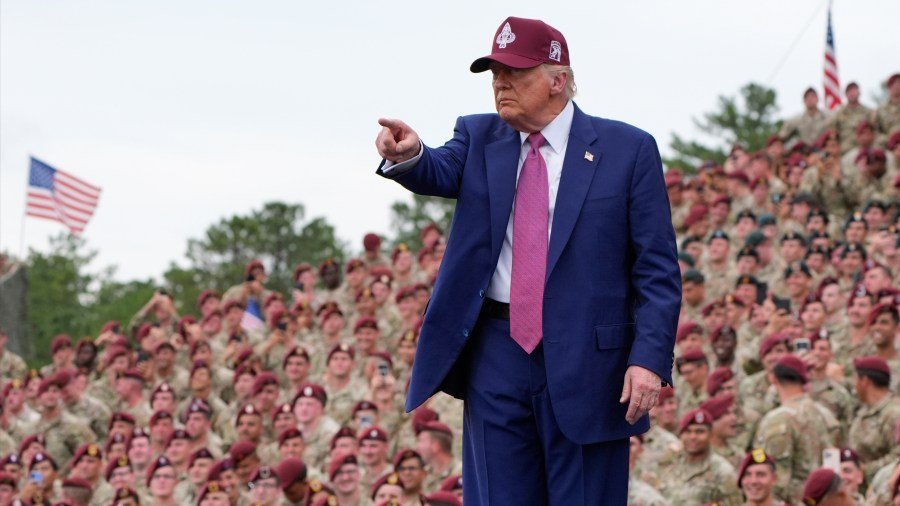
And he did it as part of what could only be described as political speech at Fort Bragg to an audience of soldiers who were screened for their political allegiances and responded with wild cheers for Trump's attacks on his political rivals.
It all put me in mind of the Immovable Ladder of the Church of the Holy Sepulchre in Jerusalem. Acclaimed since at least the fourth century as the site of the tomb of Jesus of Nazareth, the church building has been under the joint governance of Greek, Coptic, Ethiopian and Syriac Orthodox sects, the Armenian Apostolic church and the Roman Catholics since the days of the Ottomans.
Outside a window on the second story of the church, there is a rough, wooden ladder that has been there since at least 1721. No one knows when or why the ladder was placed there, but they do know that under the uneasy power-sharing arrangement between the sects, no one has the unilateral authority to move it, nor can anyone obtain the unanimous consent necessary to do so licitly. So fearful are the custodians of the church that any violations of the truce will end in rupture or even violence, that they do nothing. And so, the ladder has sat in the dry desert air for longer than the United States has been a nation.
Now, you can't run a nation like a pilgrimage church, and certainly not a nation's military. A lot more than ladders have to get moved to keep the planet's apex power in position. But the ladder does, ahem, lead up to a valuable way of thinking about how to treat even minor issues when tensions and stakes are high. When things can be left alone, it is often wise to leave them be.
The re-Confederate-ing of the military bases in the South is a small thing on its own, but so was their vestigial connection to the Confederacy in the first place. Other than Fort Robert E. Lee in Virginia, none of the other namesakes had lingered on in popular memory, except for perhaps Bragg's fellow bungler, George Pickett, most famous for a failed infantry charge. Joe Biden could have left those ladders leaning, but wanted to make a point. Now Trump has made the counterpoint, and we might expect that the next Democratic president may want to make the counter-counterpoint.
None of that will make the American military better, but it will make it more political, and that's very bad news.
Americans have long been suspicious about the idea of having a large standing army. One of the reasons it took us so long to get into the fray in World War II was that public sentiment demanded a nearly complete demobilization after World War I. For most of American history, the idea that there would be more than a million active-duty troops stationed inside the borders of the United States would have been a very unappealing one. Standing armies are expensive and, as the history of the world shows with crushing frequency, dangerous to the liberty of citizens.
And yet, America's military is massively popular. An impressive 79 percent of U.S. adults said in a recent poll that they have confidence in the military to act in the public's best interests. Compare that with just 22 percent for the federal government as a whole, 47 percent for the Supreme Court, 26 percent for the presidency and 9 percent for Congress.
It might be said that our military is the only federal institution that is actually succeeding these days, but certainly it is the only part of it that is broadly popular, enjoying strong public support regardless of which party is in power at any given time.
That is because in the era of large standing armies since the start of the Cold War and especially since the institution of the all-volunteer force after the Vietnam War, our civilian and military leaders have worked very hard to keep politics out of the military. Even as the greedy goblins of partisanship ripped the wiring out of every other institution that worked, the military has stood apart.
Lots of bad things happen in countries when the military is the only stable part of the government, but our highly professional, scrupulously restrained, civilian-controlled military has done an exceptionally good job of staying out of domestic politics. But now, domestic politics has stopped returning the favor.
Trump's decision to host a massive military demonstration in the streets of Washington on Saturday would have been a dubious choice under any circumstances. The occasion is the Army's 250th birthday, which also happens to fall on the president's 79th birthday. Trump will review a force of 6,600 troops and 150 vehicles including Abrams tanks, Paladins and Strykers, as well as Black Hawk, Apache and Chinook helicopters overhead as they pass in front of the White House.
It's something Trump wanted in his first term, but was refused by military leaders who said it would be too expensive and send the wrong message about the military's relationship to the government. Rolling tanks through the capital city just isn't something Americans typically do, until now.
Also in the category of Trump this week realizing unachieved goals from his first term is his mobilization of the military to suppress riots. In the summer of 2020, Trump was stymied in his efforts to use military force to smash the riots that followed in the wake of the George Floyd protests. The protesters in Los Angeles, and the copycats that one assumes will follow at other protests against federal deportation raids, have given Trump the chance to finish another unrealized goal of his first term.
You may think what Trump is doing with the protesters and rioters is correct, and it may even end up being considered legal, but the timing sure does stink.
Does anyone imagine that, rightly or wrongly, the bipartisan esteem for the military won't take a hit in all this? Setting up clashes between the Marines and Americans at the same time as the president held a political rally for himself at an Army base and just ahead of a massive military parade down Constitution Avenue doesn't exactly reinforce the idea of an apolitical military.
Indeed, one of the best reasons to not politicize the military is so that when a commander in chief has to use our forces in controversial ways, it can be free of any taint. If you want to be able to send the Marines to Compton, you'd better pass on the political spectacles.
Biden's name games with the bases or the use of the military to advance domestic political issues certainly didn't help. He moved the ladder, and now Trump is picking it up and smashing it through a window. If our political leaders keep at this, we will end up with what Americans for so long feared: a partisan military. No good can ever come of that.





No comments:
Post a Comment